
I’m All Ears: The Development of Listening Skills in an Ensemble
- May 9, 2019
In my earlier years as a band director, I was pretty good at fixing problems as they occurred in my band. I could address wrong notes, rhythms, basic articulations, musical phrasing, and intonation issues. I gradually learned, however, that I was working too hard and my students generally did not know how to solve these problems on their own. I was putting out “fires” as they happened, rather than giving my students the necessary skills to address these “fires” as (and before) they occurred.
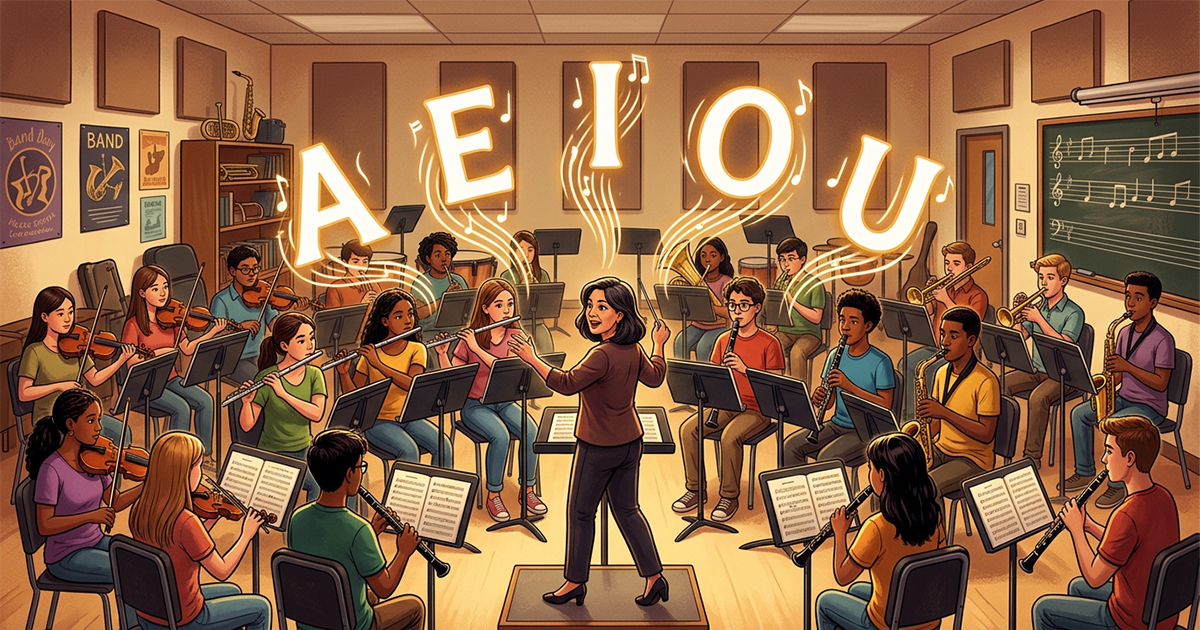
But how to address this challenge? It became clear that building better student listening skills is the key. As music educators, we must teach students to become better listeners, as this skill is the foundation of musicality at any level—beginner to professional.
In order for students to be accountable for their listening responsibilities, they need to be aware of the three basic levels of listening:
LEVEL 1: Listening to yourself.
LEVEL 2: Listening to one’s section
LEVEL 3: Listening to the entire ensemble
These are sequential skills, meaning that a musician must execute LEVEL 1, then 2, then 3.
LEVEL 1: Listening to yourself. First and foremost, a musician must always listen to him- or herself for a characteristic sound appropriate to the style of music, making the necessary self-corrections continuously. This means monitoring the fundamentals, including breathing, posture/hand & body position, articulation and note shaping (start, sustain, & release), intonation, and vibrato. Certainly, as a player advances, the level of self-critique and adjustment will rise, as it should. It is a continual process. Ultimately, the goal should be to produce a “high definition” sound: clear, instant, vibrant, colorful, and resonant—all of which will also ensure pristine intonation. In the words of longtime Chicago Symphony Orchestra principal trumpet Adolph Herseth, “When a note sounds beautiful, it is in tune (and vice versa).”1
LEVEL 2: Listening to your section. When performing in larger ensemble settings, musicians’ listening must extend beyond themselves, to the next level. This may involve homogeneous or heterogeneous combinations. If a part is written for six trumpets, then trumpet players should obviously
listen across that section. However, if a soli passage involves all flutes, 1st clarinet, and oboe, this woodwind grouping may be considered a “section” as well and should be observed by all included. Whatever the particulars, each player is now responsible for both LEVEL 1 and LEVEL 2 listening. It is the responsibility of the individual players in that “section” to listen for pitch, balance, true intervals, rhythmic precision, articulation/style continuity, clean starts/releases, and more, and to conform across the section. Rather than having students circle an mp dynamic marking, we can instruct them to write in their music, “fit into trumpets” or “listen to the flute vibrato.” Since musical markings are relative anyway, it only makes sense to instruct our students in what or who to listen to.
Legendary conductor and music educator Richard Floyd is even more prescriptive when he states “take your trio with you.”2 In other words, a musician should always listen to him or herself plus two other players and match pitch, articulation, style, and volume/balance. This gives the player a foolproof listening approach even when sight-reading or when the musical terrain is unfamiliar.
LEVEL 3: Listening to the entire ensemble. This third level of listening ties everything together. Maybe the percussion section is playing an ostinato that accompanies the woodwinds and brass. Percussionists must listen to their own individual sounds, must lock with their percussion section mates, and must balance with the rest of the ensemble as a whole. This would be an example of musicians displaying all three levels of listening, and it points to one of my favorite sayings by University of North Texas Wind Symphony conductor Eugene Corporon: “We don’t come to rehearsal to learn our part, rather to learn everyone else’s part.”3
Of course, we can’t just tell our students to listen on these three levels. Listening skills are learned skills. So how do we develop these assets in our ensembles? One of the best ways is through the performance of intervals, beginning with unisons and octaves. When we produce a Concert F in the middle of each instrument’s range in a full band setting, we are producing a unison note in at least four different octaves. Learning to listen and match the unisons and octaves to be in tune and balanced is a challenge for any ensemble and hones listening skills like nothing else. Playing unison melodic studies is equally valuable.
Once unison/octave listening is established, the sequence roughly follows the harmonic series and the inversion of these  intervals: perfect fourths and fifths, then major and minor thirds and sixths, and finally major and minor seconds and sevenths. Introduction to the terms consonant and dissonant will help students become even more attuned to what they are hearing. Not only should proper intonation be listened for, but also equal balance between the notes of the intervals. This goes for all three levels of listening and is equally valuable for both winds and percussion.
Throughout the above processes, students need to be made aware of the importance of both horizontal and vertical listening (sometimes also referred to as melodic and harmonic listening). If they are playing a musical line, they need to listen that sequential intervals are “true” or in tune with each other (horizontal). This is especially the case when listening at LEVEL 1. At LEVELS 2 and 3, vertical listening comes into play, not only in terms of intonation, but also balance.
A superb exercise to help develop listening awareness in an ensemble is the “pass through” exercise, first introduced to me by Eddie Green, Professor Emeritus at the University of Houston. All three levels of listening can and should be applied to this exercise.
• Assign each student in the ensemble to either group “A” or “B.”
• Have group A sustain a Concert F
• Have group B start on a Concert F, move up a major second (Concert G), and then cadence on the third (Concert A). Well-trained students will actively listen to and identify the dissonant quality of the M2 and understand that balance must be achieved for this
interval to sound correct. After this “pass through” the dissonance, the consonant M3 can be played with good balance and intonation.
• Continue to the fourth, fifth, sixth, seventh, and finally the octave.
Since the interval of a fifth (Concert F and C) is so fundamental to aural skill development, I like to do various exercises after arriving there. I may, for example, do a Remington-style routine in parallel fifths…

or an articulation drill on static fifths…

After playing an exercise such as this, it is imperative to assess students for understanding. Ask questions such as, “Did anyone hear someone that was either out of tune, unbalanced, not matching articulation?”
Once two-note intervals are firmly established, listening to/ playing triads is the next step. Students should learn to hear the differences between just tuning and equal temperament and use the former for proper performance of chords.
• Establish root of chord with focus on pitch and volume.
• Add the fifth of the chord. Focus on balance, stretching the fifth (could be fourth below), and tuning the root.
• Add the major third of the chord, slightly lowering the pitch. Fit in the root and fifth with proper balance.
This procedure and sequence is the same for minor chords except raising the third (minor) slightly.
Of course, listening with intention to intervals and chords is only the tip of the iceberg. Rhythmic precision, note shaping, articulation, dynamics, instrumental color, texture, form...these are all musical elements that can and should be on musicians’ aural radars. Listening skill development is a long, slow, neverending process that has many levels of proficiency. For teachers, it can take a little more time in rehearsal, but is well worth the effort. By giving students the responsibility of listening as a means of ultimately fixing problems, you are giving them the skills to put out the “fires” on their own. When your students auto-correct a passage of music, you may just catch yourself smiling.
1. Kent, Tim. “Herseth Lesson Notes.” Herseth Lesson Notes. N.p., n.d. Web. 18 May 2016.
2. Williamson, John E, and Kenneth L. Neidig. Rehearsing the Band. Cloudcroft, NM: Neidig Services, 1998, p. 60.
3. Williamson, John E, and Kenneth L. Neidig. Rehearsing the Band. Cloudcroft, NM: Neidig Services, 1998, p. 18.
 Jeff King is the Director of Bands for the Duncanville ISD where he oversees the instrumental program for the district and conducts the Wind Ensemble. Mr. King has authored several books and is an active clinician, and currently serves on the Board of Directors for the Texas Bandmasters Association.