
Jazz Ensemble Literature – Balancing Technical, Aesthetic and Curricular Needs
- Sep 9, 2019
When selecting repertoire, the best results will usually occur when a methodical approach is taken. One such method is to consider each piece of music by three distinct measures: 1) Technical 2) Aesthetic 3) Curricular. Applying these criteria can be a balancing act but will more often than not result in the selection of materials that motivate and inspire students while developing their performance skills, and overall musical understanding and appreciation.
Technical considerations.
When beginning to evaluate a piece of music, it is best to start with the most objective elements: those that relate to the technical aspects of repertoire. A band cannot successfully perform music that is beyond the technical ability of the players. Conversely, the band will not grow musically if it is regularly playing repertoire that is far too easy. Striking the balance between accessibility and pushing the envelope is one of the most challenging tasks for any director when choosing music. As a rule, choosing repertoire that is derived from several different points along this continuum is most advantageous. A level of honesty regarding what the band can and cannot play is critical. Use the guidelines found in “Excellence in Jazz Pedagogy, Volume 1” to assist you in accurately defining the true level of your ensembles.
Instrumentation. Standard jazz ensemble instrumentation is 5 saxophones, 4 trumpets, 4 trombones, and rhythm section. In many school settings, the instrumentation may be quite different for a variety of reasons. It is important that repertoire chosen is scored for the instruments available - whatever they might be. The FlexJazz Series from Kjos offers grade 1-2 level charts that are playable by nearly any combination of 4 instruments plus rhythm section. The First Place for Jazz: Charts and Standard of Excellence Jazz In Concert are both scored for full jazz ensemble but playable with as few as 3 reeds, 3 brass, and 3 rhythm players. Each of these series also includes parts for flute, clarinet, F horn, tuba, and baritone/euphonium.
Brass ranges. The lead trumpet part is the highest voice in a jazz ensemble and carries the melody for a good portion of many charts. Therefore, it is necessary to have a clear knowledge of the practical range and upper range of your band’s lead trumpet player when reviewing potential literature. Practical range is defined as notes that the player can perform with a full sound, good articulation, and in tune most of the time. Check the lead trumpet part of any chart that you are considering and make certain it is mostly within the practical range of the lead player.
Rhythm section. When selecting charts for students, the Achilles heel of a work is often the way parts are written for the rhythm section. It is critical to deliberately examine rhythm section parts to make certain your players will be able to accurately perform them. If not accessible to the rhythm section, further consideration of a chart is futile.
Soloist demands. Improvisation is the essence of the jazz experience, and as such, almost every jazz chart will include the opportunity for solo improvisation in some form. When examining repertoire, make certain the solo sections are consistent with the improvisational abilities of your players.
Aesthetic considerations. Just because a work’s technical demands are in sync with our ensembles’ abilities does not automatically affirm a chart as worthy of performance. There is a great deal of technically playable literature available, but…is it good music? Some things to consider when making aesthetic considerations on music could include:
- Does the piece have a well-conceived formal structure?
- Are creative melodies and countermelodies used?
- Is there an opportunity for harmonic imagination?
- Are the rhythms of the piece characteristic of the style represented?
- Is there contrast in all elements?
- Does the scoring best represent the full potential of tone and timbre?
- Is there an overall emotional impact?
In selecting literature, gaining experience with and exposure to as much outstanding repertoire as possible provides us with the knowledge and benchmarks necessary to make better judgments when considering the aesthetic values of a piece of music. It ensures that the decision-making process is as complete, effective, and unbiased as possible.
The easiest way to gain a sense of good repertoire is by listening to and watching—and comparing and contrasting—audio and video recordings of jazz. There is more jazz-related media at our disposal than at any time in history, and it is a tool that we should put to serious use. More valuable, albeit more demanding, is frequently attending live performances and performing jazz ourselves—walking in the shoes of our students and practicing what we preach. It is a never-ending, evolutionary journey. For example, many of us can point to recordings that we heard early in our development that, at the time, we very much liked or disliked for any number of reasons. Hearing them now with more mature ears, we discover that they seemingly have become very good or very mediocre—worthy yardsticks for our musical judgment, thumbs up or down. Of course, the music itself did not change—only our perception and understanding of it. It is a natural part of our evolution as artists and teachers.
Curricular considerations.
Jazz ensembles, like all school music groups, are teaching vehicles at their core. Students are best served when the chosen repertoire is in alignment with overall educational goals. In the case of the jazz ensemble, multiple curricular decisions on several levels come into play.
Instrumental curriculum. Music played by the jazz ensemble must fit into the universal educational goals of a school’s instrumental music program.
Historical variety. Repertoire chosen for a jazz ensemble should encompass a broad survey of jazz history. Be sure to include classic swing and swing era repertoire, standards, and contemporary literature.
Stylistic variety. Besides considering the historical implications of repertoire selection, we must also offer performers a balanced diet that encompasses the wide array of jazz styles that fall in the more general categories of swing, rock/funk, and Latin.
Finally, one must never sell short the eminent role of improvisation in jazz when considering curricular goals. Improvisation is widely viewed as an essential of music education and is an important part of most local and national music education standards. Unfortunately, it is a skill that seldom finds its way meaningfully into conventional performance classrooms…unless it’s a jazz classroom! And by offering a diverse collection of jazz repertoire, students are exposed to a host of improvisation practices and the theory that accompanies them—in ways accomplished by no other form of music study.
Jazz is complex, and requires thought, effort, and attention to be fully appreciated and understood. We must bring all of those faculties to bear when considering the technical, aesthetic, and curricular aspects of music for a jazz ensemble. Consistently working to expand the quest for quality literature will help to ensure we make better repertoire decisions moving forward. Isn’t that the same kind of growth we expect from our students?
Published in Kjos Band News, Spring 2018, Volume 20 Copyright © 2018 Neil A. Kjos Music Company
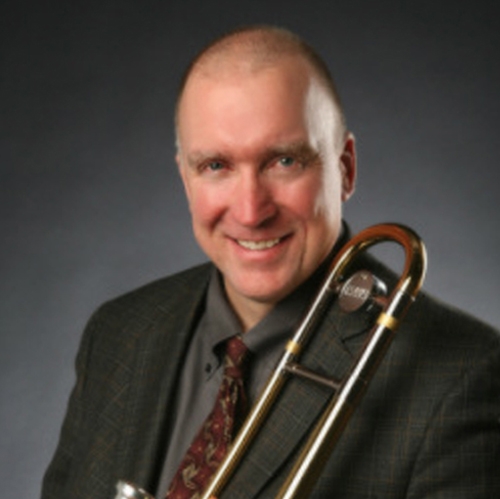
Dean Sorenson is a prolific and highly sought after composer, trombonist, and clinician. His most recent publications, the Standard of Excellence Jazz Ensemble Method, Advanced Jazz Ensemble Method, and Jazz Combo Session, are a "must-have" for developing jazz ensembles and combos.
Dean holds degrees from the University of Minnesota and the Eastman School of Music and is Interim Director of Jazz Studies and Performance at the University of Minnesota-Minneapolis. He spent two years touring the United States and Japan with the Glenn Miller Orchestra, playing trombone and writing many arrangements for the band. Dean is a Yamaha performing artist and maintains an active freelance schedule, playing for touring shows and a wide variety of local groups.